






Online parenting course
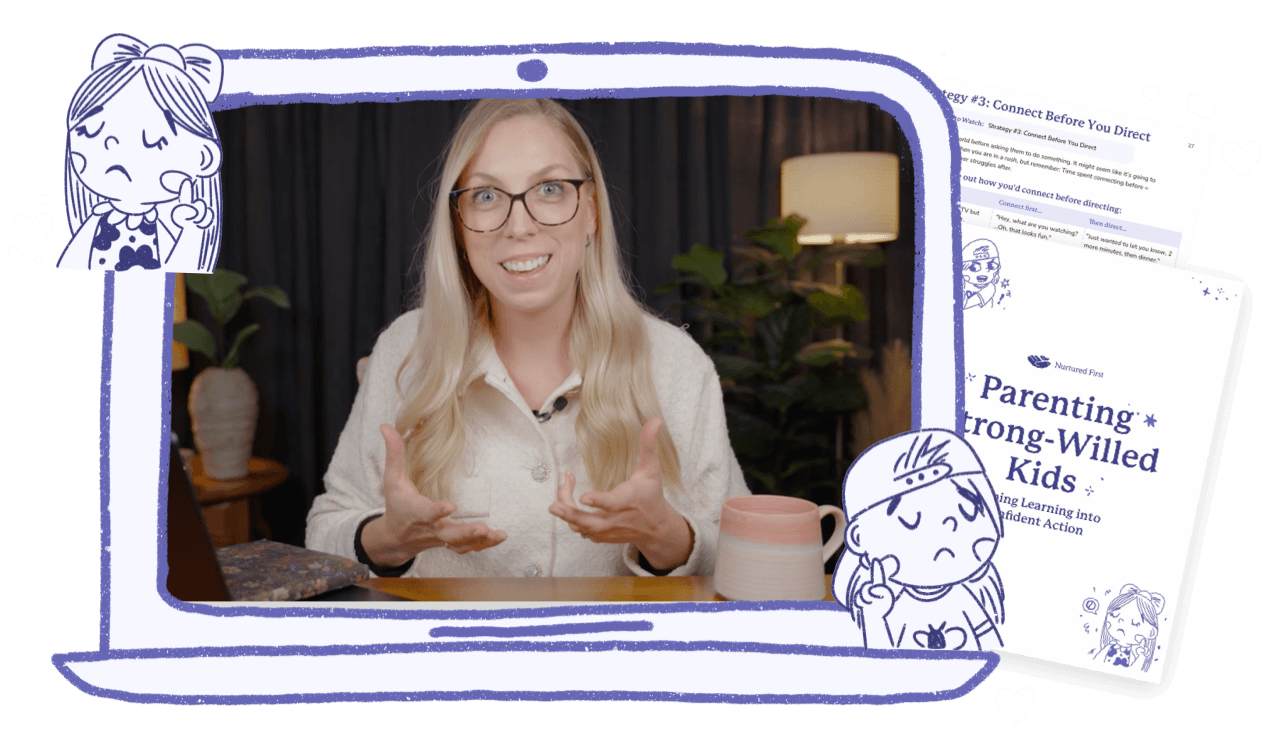
Parenting Strong-Willed Kids
For parents of children ages 2 to 8, when getting dressed, sitting down to dinner, and going to bed have each turned into a standoff.
If any of these sound familiar, you're in the right place.

Every small thing turns into a standoff.
Getting dressed, sitting down to dinner, putting shoes on to leave, going to bed. Each one becomes a negotiation, then a fight, and by the end of the day you are worn out from pushing against a child who will not budge.

You have tried giving in and cracking down, and neither one holds.
When you let it go to keep the peace, it happens faster the next time. When you come down hard with consequences, the pushback only gets bigger. You are out of ideas and starting to feel like nothing works with this kid.

You love their fire, and you're scared of crushing it.
You can see the determination is going to serve them one day. Right now it's wearing you down, the flat "no" in public makes you brace for the looks, and you quietly wonder how to support them without breaking their will.
Get started today
Parenting Strong-Willed Kids
US$44.49
- 32 short video lessons, each under 5 minutes, across 5 modules
- A printable companion workbook, so the strategies are in one place when you need a quick reminder
- 12 practical, connection-based tools you can start using right away
- On any device
What you'll learn
See the Pushback Differently
Why your child digs in. Learn why a strong-willed child pushes back, and why it is communication and an unmet need, not manipulation or a character flaw.
Why both usual approaches backfire. See why giving in to keep the peace and coming down harder both work for a moment, then make the next standoff bigger.
The determination underneath. Start to see the stubbornness as the early shape of a strength worth protecting, which quietly changes how you respond to it.
Find the Root Cause
The brain's alarm system. Understand what is happening in your child's developing brain when they refuse, so the behavior stops feeling like defiance and starts to make sense.
The five reasons behind it. Learn to tell separation, sensitivity, fear, and plain tiredness apart, because each one asks for a different response.
Get curious, not furious. Trade your first hot reaction for one real question, and let what your child is actually struggling with come into view.
Respond With Confidence
Stay steady when they dig in. Find out why your child's resistance hooks your own stress, and get tools to keep your cool and co-regulate instead of snapping.
The words for the hard moments. Get specific scripts for "no," the dinner-table standoff, the bedtime protest, and the morning everything grinds to a halt.
Lead without breaking the will. Hold a firm boundary and stay close at the same time, fill your child's need for power and control in healthy ways, and repair after the times you lose it.
See what's included
Five modules and 32 short video lessons, each under five minutes, plus a printable companion workbook. The lessons are short on purpose, so you can learn one strategy while the kettle boils and try it that afternoon. Open any module to see every lesson.
Most of us were taught that a child who pushes back is being difficult. This module turns that around, so you start to see the pushback as your child telling you something rather than testing you.
Welcome to the Course
Video
Why Your Child Pushes Back
Video
Good Kids, Communicating a Need
Video
There are two go-to ways to handle a strong-willed child, and you have probably tried both. Here is why giving in and breaking their will each fall apart, and what to aim for instead.
Approach #1: Giving In
Video
Approach #2: Breaking Their Will
Video
Defiance is the surface. Underneath it sits a reason, and usually it is one of five. This module helps you find which one you are actually dealing with.
The Developing Brain's "Alarm System"
Video
Root Cause #1: Separation
Video
Root Cause #2: Sensitivity
Video
Root Cause #3: Fear
Video
Root Cause #4 & #5: Lack of Sleep and Rest
Video
This is the practical heart of the course: 12 strategies you can start using today, built on co-regulation and on steadying yourself first.
Introduction to the Toolkit
Video
The Power of Co-Regulation
Video
The First Step: Nurturing Yourself
Video
Understanding Your Own Triggers
Video
Strategy #1: Nurture the Relationship First
Video
Strategy #2: Allow All Feelings
Video
Strategy #3: Connect Before You Direct
Video
Strategy #4: Add in Playfulness
Video
Strategy #5: Tell Stories of Sameness
Video
Strategy #6: The Do-Over and the Repair
Video
Strategy #7: Be the Confident Leader (Set Boundaries)
Video
Strategy #8: Get Curious, Not Furious
Video
Strategy #9: Ask "What's Up?"
Video
Strategy #10: Allow Desires in a Wondering
Video
Strategy #11: Teach a Missing Skill
Video
Strategy #12: Fill Their Need for Power & Control
Video
Watch the whole approach come together on the battles parents ask about most, from the dinner table to the after-school meltdown.
Scenario 1: The Child Who Won't Sit at the Dinner Table
Video
Scenario 2: The Child Who Protests and Delays Bedtime
Video
Scenario 3: The Child Who Fights the Morning Routine
Video
Scenario 4: The Child Who is Defiant After a New Baby
Video
Scenario 5: The Child Who Melts Down After School
Video
Scenario 6: The Child Who Says "No" to Everything
Video

Jess VanderWier
Registered Psychotherapist and mom of three
Jess VanderWier is a Registered Psychotherapist and the founder of Nurtured First. For years she has helped parents who love their spirited, determined kids and are worn down by the daily power struggles, teaching a way through that leans on connection and brain development instead of punishment or breaking a child’s will.
She is also raising a strong-willed child of her own, so she knows the dinner-table standoff and the flat “no” from the inside, not just from across a therapy room. She teaches the way a good friend would, warm and honest, with the exact words to try when your child pushes back.
What makes this course different

It starts one step before the behavior.
Most advice jumps straight to making the pushback stop. This course begins with why it is happening, because a standoff you understand is one you can actually change, instead of a script you reuse until it stops working.

You watch a therapist use the words.
Instead of reading a tip and hoping you get it right, you see Jess handle the flat “no,” the dinner-table dig-in, and the bedtime protest in real time, including her tone and her timing. You learn what calm and firm sound like together.

It matches the response to the reason.
The move that settles a tired, overwhelmed child is the wrong one for a child who is scared or overstimulated. You learn to read which root cause you are dealing with and reach for the strategy that actually fits, instead of trying the same fix on every standoff.

It protects the strong will instead of breaking it.
The determination that exhausts you now is the same trait that will help your child stand their ground as a teenager. You learn to hold the limit and keep the spirit at the same time, with no punishment and no power struggle for its own sake.

Built for the parent running on empty.
You do not have to start at lesson one or finish the whole course to get help today. Jump straight to the bedtime fight or the morning meltdown you are facing right now, try one strategy, and come back for the rest when you have the energy.
Their strong will can stay, and home can feel more peaceful.
This was never about a child who never pushes back, but about fewer standoffs that spiral, quicker repair when they happen, and a strong-willed kid who feels understood instead of managed. Work out which of the five root causes is behind the pushback, then pick one of the 12 strategies to try tomorrow.
Frequently asked questions

Parents and caregivers of strong-willed children ages 2 to 8 who are tired of the daily power struggles over getting dressed, eating, leaving the house, and going to bed, and who want a way to respond that works now and as their child grows.
The course is built for ages 2 to 8, where the examples land most squarely. If your child is around 18 months and already digging in, the foundations still apply and you will be ready for what is ahead. The principles hold past 8 as well, even though the scenarios are aimed at the younger years.
Yes. The course is written with sensitive, spirited, and intense children in mind, and one of the five root causes it covers is sensory sensitivity. The whole approach is about reading your own child rather than applying one script to every kid.
Every child tests limits and gets into power struggles at some point. This course is for the parent who is not sure how to respond to a child who pushes back hard and often, and who wants to handle those moments with more confidence and less yelling.
No, and any course that promises that is not being honest. Testing limits is part of being a kid. What this gives you is the understanding to know why a standoff is happening and the tools to respond so the standoffs come less often, settle faster, and leave you both feeling closer instead of further apart.
There are 32 lessons and the longest is under 5 minutes. You can learn one strategy in a spare few minutes and try it that day, take a module at a time, and skip straight to the struggle taking over your house right now. The printable workbook keeps the key strategies handy, so you are not rewatching a lesson to remember the words.
Yes. Comments are turned on for the course videos, so you can ask a question right under the lesson you are watching.
Free tips can genuinely help, and plenty of parents start there. A tip tells you what to do in one moment. This gives you the whole system: a framework that builds lesson by lesson, a workbook you can keep on hand, and real-life walkthroughs for the exact battles most parents face. If a few free ideas have already settled things at your house, you may not need this. If you have tried the tips and still freeze when your child digs in, this is the part they leave out.
The Anger Course is for when big feelings come out hot, loud, or physical, and it focuses on building emotional regulation. Parenting Little Kids is the broad foundation for ages 0 to 12. This course goes deep on one thing: why a child pushes back against your requests, and the scripts and tools to respond to those power struggles with confidence.
No. This is parenting education. It does not diagnose anything, and it does not replace therapy, medical care, or other professional support. If you are worried about your child’s safety, development, or mental health, please work with a qualified professional.
You have 30 days from purchase to request a course refund if it is not the right fit and you have completed 50 percent or less of the course content. See the refund policy for the full terms.
Related resources
Support your child's whole world

Parenting Little Kids
For the tantrums, the hitting, and the yelling you swore you would never do. Short video lessons that help you understand what is driving the behavior and respond without punishment, for ages 0 to 12.
Setting Boundaries
For when you cannot tell whether you are being too soft or too strict. Video lessons on what a boundary really is, how to hold it without yelling, and what to say in the daily battles, for ages 1 to 12.
The Anger Course
For the screaming, the hitting, and the slammed doors. Video lessons that help you see what is fueling your child’s anger, catch it earlier, and stay steady when their big feelings hook yours, for ages 3 to 9.
